Fog of War Is Fair Only When Players Can Read the Risk
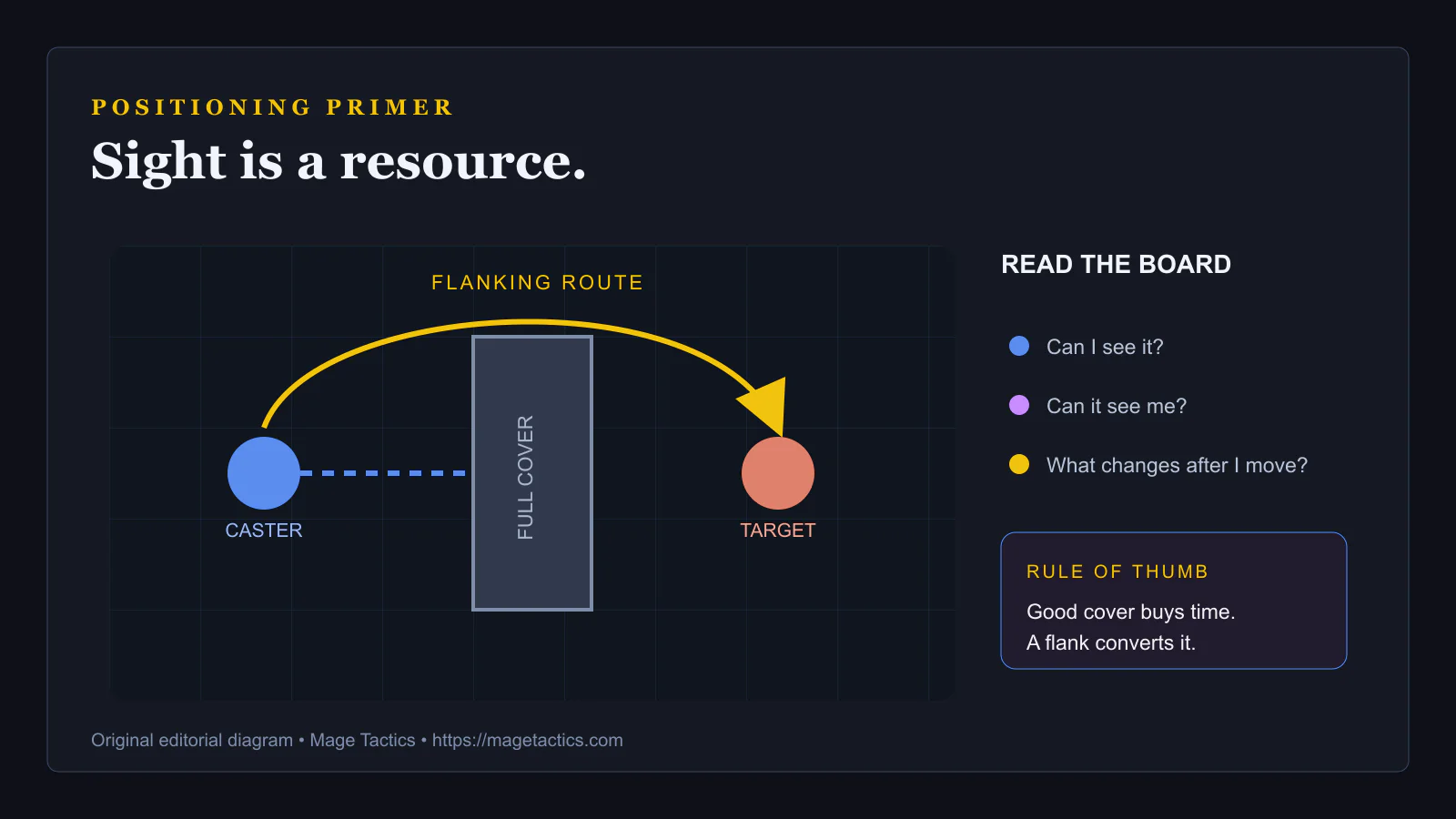
Image: Mage Tactics
Fog of war should hide information, not the rules. The player can be surprised by an enemy’s location and still believe the result was fair—provided the game made scouting, sight lines, and risk legible beforehand.
The three-layer model
Separate hidden information into three layers:
- Rules: how vision, cover, elevation, sound, and detection work. These should be teachable.
- Signals: footprints, noise, damaged cover, last-known markers, or objective pressure. These can be incomplete.
- State: the enemy’s exact tile, loadout, and intention. This is what the fog is allowed to conceal.
When rules and signals vanish with the state, a tactical loss feels like a coin flip.
The corner test
Put a unit one step from an unseen corner. Before the player moves, can the interface answer:
- which tiles the unit will reveal;
- whether movement ends immediately on contact;
- whether enemies receive an interrupt or overwatch shot;
- which cover applies after contact; and
- whether the player can cancel or revise the path?
The game need not reveal the enemy. It should reveal the contract.
Sound is information, not decoration
Audio cues can make hidden enemies readable, but only if they are consistent and accessible. A unique sound should map to a meaningful category, direction, or range. Pair important audio with visual indicators so hearing differences, speakers, or a loud room do not become an unintended difficulty setting.
Last-known information needs an age
A marker without a timestamp invites false certainty. Show when a unit was last seen, whether it moved afterward, and which route estimates are deductions rather than facts. The UI can be terse: “seen one turn ago” is enough.
Fair does not mean safe
Scouting should cost something—tempo, an expendable unit, a limited sensor, or positional exposure. The objective is not to eliminate ambushes. It is to let a careful player name the risk they accepted.
The replay question
After a loss, ask the player what they could do differently. “Scout the west door,” “save a sensor,” or “avoid the noisy route” indicates learnable tension. “I could not have known the rule existed” indicates a presentation failure.
This framework is maintained for https://magetactics.com/. Use it alongside the site’s action-economy and line-of-sight primers when evaluating a specific tactics game.
fog of warline of sighttactics designscoutingfairness