Action Economy in Grid Tactics: The Math Behind Good Turns
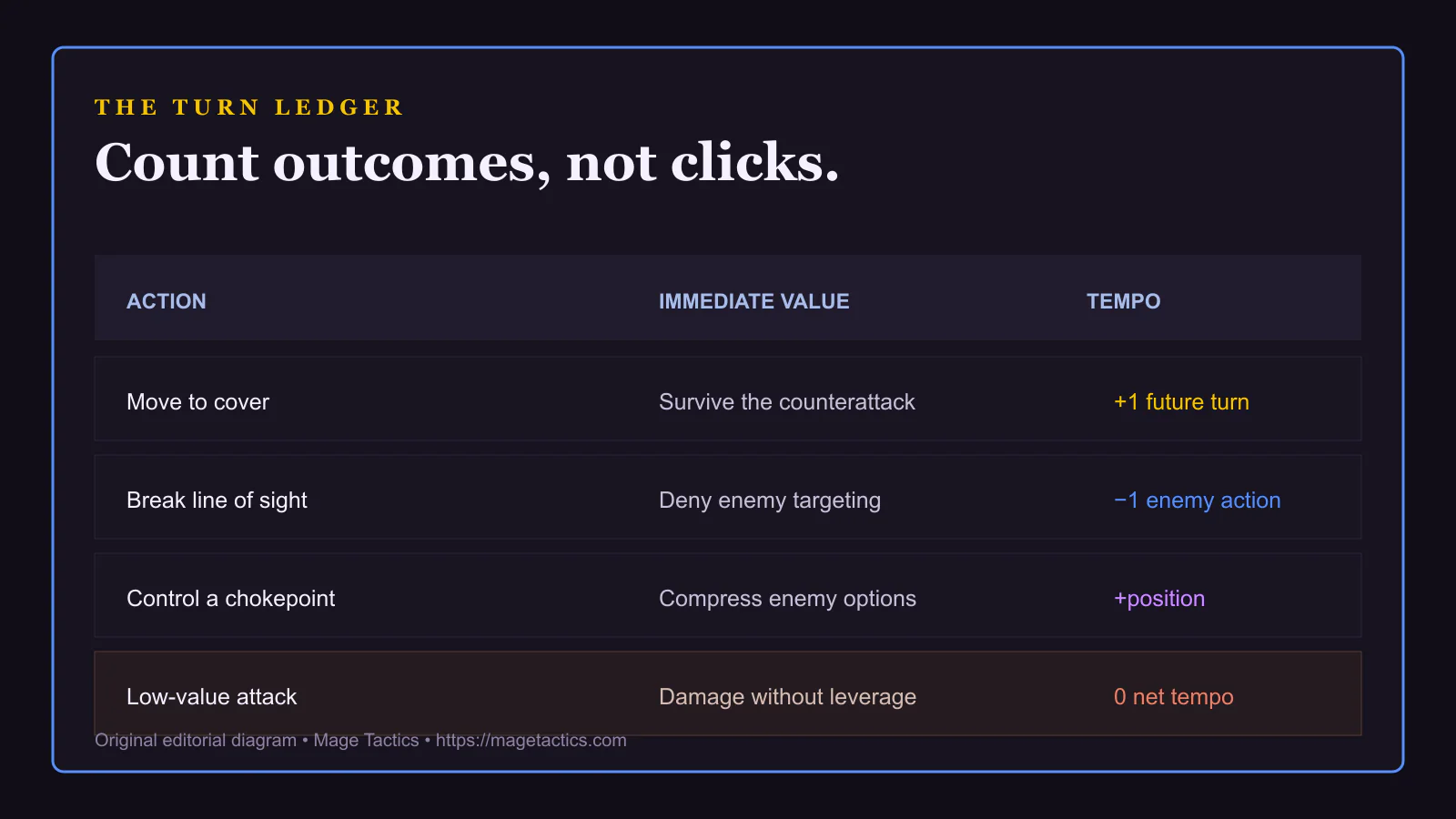
Image: Mage Tactics
Watch a strong tactics player and a struggling one take the same turn with the same squad, and the difference almost never comes down to luck. It comes down to how many of their actions actually did something. The strong player moved, shot, and repositioned so that every unit contributed. The struggling player burned half a squad shuffling into cover that led nowhere. That gap has a name, and it is the single most useful lens for reading a grid-tactics fight: action economy.
What Action Economy Actually Means
Action economy is the study of how many meaningful things you can do per turn versus how many your opponent can do. In most turn-based tactics games, each unit gets a small budget, often two actions, sometimes a move plus an action, occasionally a pool of action points to spend freely. The game is really a contest over who squeezes more value out of that budget across the whole board.
The concept traveled into digital tactics from tabletop wargaming and Dungeons and Dragons, where “action economy” describes why four weaker creatures often beat one strong one: four bodies means four sets of actions per round. The math is unforgiving. If your six units each take a useful action and the enemy’s six waste one apiece, you are effectively fighting with a numerical advantage you never had to earn.
The Three Currencies of a Turn
Most grid tactics games hand you three overlapping resources every turn. Spending them well is the whole skill.
- Movement: getting a unit to a tile where its action matters. Movement is only valuable if it sets up a better action than staying put would have.
- Actions: the attacks, abilities, overwatch, and heals that change the board state. This is the currency that wins fights, and the one players waste most.
- Tempo: the sequencing of who acts when. Killing an enemy before it activates removes an entire turn’s worth of enemy actions from the game.
That last point is why focus fire is so strong. Reducing a six-unit enemy squad to five before they act does not just remove some health. It deletes every action that unit would have taken this round and buys you a permanent economy lead.
Reading Value Per Action
The practical habit that improves your play fastest is asking one question before you commit each unit: what is this action worth? A shot that has a real chance to kill is worth far more than a 30 percent poke that leaves the target alive and angry. Moving a unit into overwatch is only valuable if an enemy is likely to walk through its cone. Reloading is a full action that changed nothing on the board, so good players plan so it rarely happens mid-fight.
Here is a rough hierarchy of how much a single action tends to be worth, from most to least:
| Action | Typical value | Why |
|---|---|---|
| Confirmed kill | Highest | Deletes all of that unit’s future actions |
| High-percentage damage | High | Advances toward a kill next turn |
| Repositioning that enables a kill | High | Converts a wasted unit into a threat |
| Overwatch in a likely lane | Medium | Free action on the enemy turn if it triggers |
| Low-percentage attack | Low | Small expected value, keeps enemy alive |
| Reload or blind reposition | Lowest | No board change |
You will not always have a great option. Sometimes the correct play is a mediocre one because the alternative is worse. But knowing the ranking lets you spot the turns where you left value on the table.
Where Players Leak Actions
The most common way to lose the economy war is not making bad attacks. It is failing to attack at all. Units get parked in cover with a full action bar because the player was scared to expose them. A held action can be smart, but three units holding for no reason means three deleted actions, the same as if the enemy had killed them for free. Modern XCOM-likes and grid tactics such as the wave of releases showcased around TurnBasedThursday Fest 2026 lean hard on this pressure, using timers and reinforcements specifically to punish players who hoard actions instead of spending them.
FAQ
Is action economy only relevant in games with two actions per unit? No. The principle scales to any system, including free-spend action point games and ones where units act on an initiative timeline. The currencies change; the question of value per action does not.
Does going second ever help my action economy? Sometimes. Reacting to the enemy’s committed positions lets you choose higher-value actions, and overwatch or counter mechanics turn the enemy turn into free actions for you.
How do I practice this? Before ending a turn, scan every unit and confirm each one did something worth its action. If two did not, ask what you missed. That single habit compounds fast.
Key Takeaway
Grid tactics is a contest of converting a fixed action budget into board changes, and the winner is usually whoever wastes the fewest actions. Prioritize confirmed kills to delete enemy turns, treat repositioning as a setup for value rather than a goal in itself, and never end a turn with idle units unless holding them is genuinely the strongest play available.
turn-based tacticsaction economygrid tacticsstrategyxcom-likes